Showing posts with label Automotive. Show all posts

Friday, February 3, 2012

Audi Q1 under consideration

According to a recent report, Audi is considering additional variants based on the A1.
As one source told What Car, "You've seen how our SUVs have been getting smaller - Q7, Q5, Q3 - and the A1 platform could go in that direction, but nothing is planned for the near future."
The latter comment is interesting, but previous rumors have suggested the crossover could be launched anywhere from 2013 to 2016.
Regardless, the insider said an A1 Cabriolet is unlikely because it would be positioned to close to the A3 Cabriolet.

Source : http://www.worldcarfans.com

New bi-turbo tdi packs even more punch into Audi A6 and A7 sportback

The most potent Audi V6 TDI ever to enter production powers executive class Audi models to 62mph in a fraction over five seconds and returns up to 44.1mpg


  • Advanced new biturbo TDI engine heads diesel line-up in A6 Saloon, Avant, allroad quattro and A7 Sportback ranges – OTR prices from £43,810
  • Available now in A6 Saloon and Avant and A7 Sportback, and later in 2012 in A6 allroad – first deliveries in spring
  • 313PS from 3,900-4,500rpm, 650Nm from 1,450 to 2,800rpm
  • A6 Saloon 3.0 BiTDI quattro – 0-62mph in 5.1 seconds, governed 155mph top speed, combined MPG 44.1, CO2 169g/km
  • Sound actuator in exhaust system accompanies remarkable performance with sports car exhaust note
Knockout punch in a velvet glove comes courtesy of a formidable new 313PS Audi Biturbo TDI engine, which is now available for A6 Saloon and Avant and A7 Sportback models. The new twin-turbo V6 is notable not only for being the most powerful six-cylinder diesel engine ever offered by the Vorsprung durch Technik brand, but also the sweetest-sounding. Available now in A6 models priced from £43,810 OTR, and from £51,645 OTR in the A7 Sportback, it combines trademark Audi TDI refinement with an exhaust-mounted sound actuator that enables it to deliver its mighty 650Nm output to the tune of a distinctly sporting soundtrack.
Slotting in above the single-turbo 204PS and 245PS versions of the 3.0 TDI that already feature in the A6 and A7 Sportback ranges, the latest V6 has a two-stage turbocharger group that delivers a maximum boost pressure of up to 3.2 bar, helping the A6 3.0 BiTDI quattro Saloon to lunge at the horizon and pass the 62mph marker in as little as 5.1 seconds, and the A6 Avant and A7 Sportback to do the same in just 5.3 seconds. An electronically limited top speed of 155mph is common to all versions.
Like the existing TDI engines, the new star performer is backed up by technologies from the Audi modular efficiency platform, including start-stop and recuperation systems and the innovative thermal management system that quickly brings the coolant and oil up to their operating temperatures. With their help, combined economy in A6 and A7 Sportback models is on an equal footing at 44.1mpg – an impressive figure given the high outputs and low acceleration times involved.

Sound actuator

Thanks to an innovative actuator in the auxiliary channel of the exhaust system, the BiTDI A6 and A7 Sportback models don’t sound like they should be capable of such level-headed economy figures. The actuator system essentially consists of a speaker which imposes a defined oscillation pattern on the exhaust flow and transforms the typical TDI exhaust note into a more sonorous roar that is closer to the output of a high-performance petrol engine.
Without exception, power is transmitted from the BiTDI engine via an eight-speed tiptronic transmission to the latest generation quattro all-wheel-drive system, which features a self-locking centre differential and torque vectoring for optimum traction and stability. A sport differential which distributes power in continuously variable proportions between the rear wheels is available from the options list to sharpen and quicken response even further.
The mighty new BiTDI engine is available in conjunction with SE and S line specification in the A6 Saloon, A6 Avant and A7 Sportback. The forthcoming A6 allroad quattro, due to open for order in February, will also offer this exceptional unit.
Stand-out features common to all these models include satellite navigation linked to a 6.5-inch retractable colour monitor, Milano leather upholstery, the Audi drive select adaptive dynamics system controlling throttle response, transmission shift points and steering feel, the Audi parking system plus, light and rain sensors, cruise control and keyless go push-button engine ignition.

Source : http://www.audi.co.uk

Thursday, February 2, 2012

Honda’s new Acura NSX supercar concept

Posted by Kelly Levinsohn in Automotive News, Autostyle, Concept car news, Super car news on 12 15th, 2011.Honda has officially confirmed that it will be showcasing its new NSX supercar concept at the upcoming Detroit Motor Show in January 2012. The next-generation Acura NSX supercar will be one of four all-new vehicles revealed by Honda next year.
Some background on Acura – it’s Honda’s upmarket wing in America that came to Europe as a Honda. It’s still fondly remembered as one of the first supercars to add comfort and ease to its pursuit of outright speed with three-time Formula 1 champion Ayrton Senna involved in its development. An earlier NSX project was scratched during the financial storm of 2008 but Honda are clearly back on track with this new project.
Aside for the confirmation of the project, Honda has not revealed much information but by looking at Honda’s latest strategy the new NSX will pioneer a more sporting hybrid application of the technology seen in lesser Hondas.
The Acura NSX is expected to be a two-seater with a lightweight build, a full zero-emissions EV capability and a launch date speculated to be in 2013.
Read More :


Source : http://100hotcars.info

2013 Kia GT to produce coupe and wagon

There have been rumours circulating that Kia was planning to build a production version of its GT concept but a new report but a new report has indicated that the new model could also be available in a wagon and coupe variant.
Citing anonymous sources, Inside Line reported that Kia is considering a series of GT-based vehicles rather than a single sedan or hatchback. The aim of this decision is likely to assist Kia in spreading out development costs while allowing the model to target a wider range of consumers.
While no date has been confirmed for the launch dates of the coupe and wagon, the standard model could be available in 2013


Read More...

Source : http://100hotcars.info

Wednesday, February 1, 2012

2012 raider S


Key Features :
  • “S” model gets even more chrome: chrome triple clamps, fork sliders, air box cover, engine covers, headlight housing, handlebar risers, etc.
  • A 6-degree yoke angle—the first ever on a Star® Motorcycle—makes it possible to achieve that custom look as well as neutral handling and straight-line cruisability: 33-degree rake plus 6 degrees yoke angle gives total rake of 39 degrees and 102mm of trail.
  • 5-spoke wheels carry a 120/70-21-inch bias tire up front, and a wide, 210/40-18 radial out back—the tallest and widest ever on a Star.
  • Estimated 42 mpg* means this cruiser can go the distance between fill-ups.

Engine :
  • 113-cubic-inch (1854cc) air-cooled, OHV with 4 valves per cylinder, pushrod 48-degree V-twin pumps out max torque at just 2500 rpm and max power at 4500 rpm for powerful, relaxed cruising.
  • Four pushrod-activated valves and two spark plugs per cylinder provide optimum combustion efficiency along with classically beautiful engine architecture.
  • Ceramic-composite plated cylinders for superior heat dissipation with forged pistons cooled by oil jets. Provides outstanding reliability and longer engine life.
  • 9.48:1 compression ratio and aggressive cam timing increase power output across the board.
  • Computer-controlled, twin-bore fuel injection monitors multiple engine parameters to calculate perfect mixture under all conditions; wide-angle 12-hole fuel injectors provide excellent atomization.
  • A 3.5-liter airbox is hidden in the area below the fuel tank for great performance and clean styling.
  • Two-into-one-into-two exhaust with Exhaust Ultimate Power valve (EXUP®) inside boosts torque in the 2500~3500-rpm range.
  • Special custom-machining of the cooling fin edges gives a jewel-like appearance to the engine as light hits it from different angles.

Chassis/Suspension:
  • All-aluminum cast frame is lightweight, rigid and tuned for light, athletic handling. A light, Controlled-Fill, aluminum swingarm casting complements the bike’s lithe style.
  • Low, sculpted seat holds the rider in place, and pullback bars reach back to enforce a casual, urban cruising style.
  • A 6-degree yoke angle—the first ever on a street-legal Star Motorcycle—makes it possible to achieve that custom look as well as neutral handling and straight-line cruisability: 33-degree rake plus 6 degrees yoke angle gives total rake of 39 degrees and 102mm of trail.
  • Custom 5-spoke wheels carry a 120/70-21-inch bias tire up front, and a wide, 210/40-18 radial out back—the tallest and widest ever on a Star.
  • 46mm fork tubes serve a sweet appearance and an excellent ride through 5.1 inches of wheel travel.
  • A tucked-out-of-sight single shock with adjustable spring preload out back provides a smooth ride under varying loads.
  • Flangeless fuel tank carries a full 4.2 gallons of fuel.
  • Front brake master cylinder with integrated lever operates a pair of 298mm front discs squeezed by strong monoblock calipers for excellent power and feel, with a 310mm disc out back.
  • Strong, light and narrow belt final drive contains embedded carbon fiber for even greater strength.
  • Wiring harness uses super-slim wires for compactness, are lighter weight and switchgear wiring is routed inside the handlebar for a clean appearance.

 Additional Features:
  • Left-thumb operated high-beam switch, and right-thumb activated accessory driving light switch for great visibility.
  • Jewel-like fit and finish, and Star quality paint, chrome and attention to detail are evident all over the Raider S.
  • Cool, tank-mounted instrumentation complements the custom look, and contains analog speedometer and fuel gauge, along with twin digital tripmeters, odometer and self-diagnostics.
  • Bright multireflector headlight, LED taillight, and amber turn signals behind clear lenses give a custom look.
  • 02 sensor and three-way catalyst reduce emissions.

Read More ...

Source : http://www.starmotorcycles.com

Tuesday, January 31, 2012

SPECIFICATIONS NINJA 1000 ABS

SPECIFICATIONS
Engine
Four-stroke, liquid-cooled, DOHC, four valves per cylinder, inline-four
Displacement
1,043cc
Bore x Stroke
77.0 x 56.0 mm
Compression Ratio
11.8:1
Fuel System
DFI® with four 38mm Keihin throttle bodies, oval sub-throttles
Ignition
TCBI with digital advance
Transmission
Six-speed
Final Drive
X-ring Chain
Rake/Trail
24.5 deg / 4.0 in.
Front Tire Size
120/70 ZR17
Rear Tire Size
190/50 ZR17
Wheelbase
56.9 in.
Front Suspension / wheel travel
41 mm inverted cartridge fork with stepless compression and rebound damping, adjustable spring preload / 4.7 in.
Rear Suspension / wheel travel
Horizontal monoshock with stepless rebound damping, adjustable spring preload / 5.4 in.
Front Brakes
Dual 300mm petal-type rotors with radial-mount four-piston calipers, ABS
Rear Brakes
Single 250mm petal-type rotor with single-piston caliper, ABS
Fuel Capacity
5.0 gal.
Seat Height
32.3 in.
Curb Weight
509.4 lbs.
Overall length
82.9 in.
Overall width
31.1 in.
Overall height
48.4 in.
Color Choices
Metallic Spark Black / Metallic Flat Micron Gray, Candy Lime Green / Ebony
Warranty
12 Months
Good Times™ Protection Plan
12, 24, 36, 48 months 
Read More ...

Monday, January 30, 2012

The new Ferrari 458 Spider

Maranello, 23rd August – The new 458 Spider joins the 458 Italia, widening the range of Ferrari’s mid-rear engined V8s and offering the same uncompromising technological solutions, handling and performance in a refined open-top configuration. It is equipped with a Ferrari patented, fully retractable hard top, a world first for a sports car with this lay-out.

The 458 Spider is powered by Ferrari’s naturally-aspirated, direct-injection 4.5 litre V8 which was nominated as the 2011 International Engine of the Year for its engineering excellence in terms of driveability, performance, economy and refinement. The power is transferred to the road by Ferrari’s class-leading dual-clutch F1 paddle-shift transmission through the sophisticated E-Diff, itself integrated with the F1-Trac traction control and high-performance ABS for maximum handling dynamics.

Certain of the car’s features, such as its accelerator pedal mapping and the damping of the multilink suspension, have been calibrated to guarantee maximum sportiness and absolute driving pleasure with the top down, in line with Maranello’s exclusive spider tradition. Even the engine soundtrack has been honed to ensure that the car’s occupants are completely captivated by the drop-top driving experience.

Entirely in aluminium, the hard-top solution adopted for the 458 Spider offers a number of advantages over the traditional folding soft-top, including a reduction of 25 kg in weight and a deployment time of just 14 seconds. Fully integrated into the styling of the car, the hard-top was engineered to fit neatly ahead of the engine bay without compromising aerodynamics or the performance of the car. The small space needed to house the roof enables the designers to include a generous rear bench for luggage behind the seats.

The rear of the car is characterised by innovative forms with the buttresses designed to optimise the flow of air to the engine intakes and the clutch and gearbox oil radiators. For maximum comfort whilst driving top down the 458 Spider features a generously-sized adjustable electric wind stop. The design was perfected to slow and diffuse the air in the cockpit, enabling normal conversation to be held even at speeds over 200 km/h.

New technical solutions adopted for the chassis guarantee identical levels of structural rigidity with the roof up or down. The result is a car that is truly exciting to drive, blending extreme performance with the responsiveness that has always characterised Ferrari’s open-top berlinettas.

458 Spider technical specifications

Dimensions
Length 4527 mm (178.2 in.)
Width 1937 mm (76.3 in.)
Height 1211 mm (47.7 in.)
Wheelbase 2650 mm (104.3 in.)
Dry weight 1430 kg (3153 lbs)*
Weight/power ratio 2.51 kg/CV (7.42 lbs/kW)
Weight distribution fr/r 42%/58%

Engine
Type 90° V8
Displacement 4499 cc (274.5 cu in.)
Maximum power 570 CV (425 kW)** @ 9000 rpm
Maximum torque 540 Nm (398 lbs/ft) @ 6000 rpm
Specific power output 127 CV/l
Compression ratio 12.5:1

Tyres
Front 235/35 ZR20 8.5”
Rear 295/35 ZR20 10.5”

Performance
Maximum speed >320 km/h (>198 mph)
0-100 km/h <3.4 s

Fuel consumption + emissions
Fuel consumption*** 11.8 l/100 km
Emissions*** 275 g CO2/km

Gearbox
Dual-clutch, 7-speed F1

Electronics
E-Diff3, F1-Trac, high-performance ABS

Read More ...


Source : http://www.ferrari.com

HONDA CR-Z

EXTERIOR :
PERFORMANCE :
The intersection of sport and hybrid can be found under the hood of the CR-Z.
Hybrid Thrill
The CR-Z is powered by a 16-valve, 1.5-liter i-VTEC® 4-cylinder engine with Integrated Motor Assist IMA®. This combination delivers both spirited performance rarely seen in the hybrid world with impressive fuel economy[1].
IMA Power
The battery pack, positioned low in CR-Z's body structure for optimal center of gravity, supplies juice to the Integrated Motor Assist system, giving the CR-Z abundant low-rpm torque for quick off-the-line acceleration. This is an attribute unique to electric motors and something the CR-Z would not benefit from with just the conventional engine.
6-Speed or CVT
The CR-Z's sporting credentials include a 6-speed manual transmission—the first production hybrid vehicle ever to be equipped this way. The transmission allows enthusiasts to drive the CR-Z to its maximum capabilities. Those who choose the CVT automatic transmission, however, are treated to racing-inspired paddle shifters that also provide driving excitement and engagement.
Sophisticated Suspension
A low center of gravity, wide tread and a low overall height contribute to the CR-Z's excellent handling. These virtues, together with specially tuned independent front and torsion-beam rear suspension, provide an exciting blend of agility, stability and ride quality.
Read More ...


Source : http://automobiles.honda.com

Wednesday, December 28, 2011

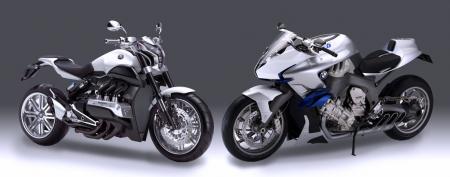
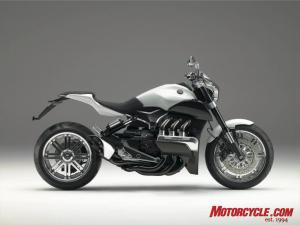
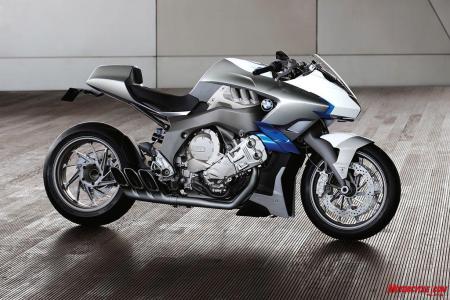
Six-Cylinder Streetfighter Shootout of the Future: Honda EVO6 vs BMW Concept 6

There are currently two motorcycles that have six-cylinder engines, and both of them power big and bulky touring machines: the BMW K1600 and Honda Gold Wing.

Both engines are large-displacement, high-torque powerplants that create sweet-sounding exhaust music, and we’ve wondered what other uses could be made from these unique engines.

We’re not the only ones, as designers from Honda and BMW have both shown concept motorcycles built around these motors, making us wonder if we might one day see a version of either enter production.

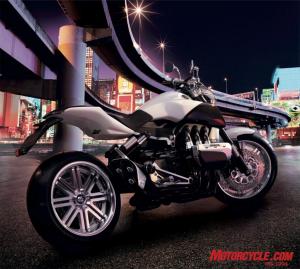
Honda was first to the game when it unveiled the EVO6 at the 2007 Tokyo Motor Show. A “Pride Fighter,” according to Honda, it was a bold concept streetfighter based around the company’s flat-Six engine from the Gold Wing.

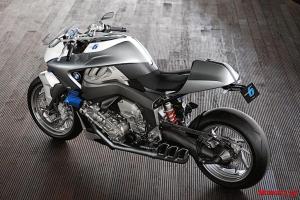
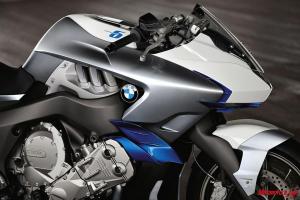
Two years later, at the EICMA show in Italy, BMW teased visitors with the Concept 6 streetfighter model based on a previously unseen inline six-cylinder engine that later debuted in the K1600 GT and GTL.

This year’s launch of BMW’s K1600 series strengthens the possibility of a production version of the Concept 6 becoming reality in the not-too-distant future. The EICMA show might’ve been BMW’s way of doing market research on the Concept 6’s viability.
With four years having passed since a public appearance of Honda’s EVO6, the promise of that model coming to fruition dims, but like the limited-production, high-concept 2005 Rune that utilized the Gold Wing mill, we could be pleasantly surprised. It could be that Honda is just sitting on its hands waiting for the global economy to recover.
With neither bike a sure thing, we decided — in the spirit of a good, old, black and white Godzilla movie — to create some science fiction of our own; to pit one concept model against another by extrapolating information from the current models they’re derived from and combining that knowledge with the limited facts presented by the respective manufacturer.
The introduction of the BMW K1600 series sheds light on what the Concept 6 is capable of achieving. In its current touring guise the inline six-cylinder engine produces a claimed 160 hp and 129 ft-lb of torque. It’s likely a streetfighter like the 6 would be given performance tuning to bump up peak output somewhere near 180 hp at the crankshaft.
The larger displacement GL engine (1832cc vs 1649cc) cranks out a relatively paltry 118 hp but a more respectable 125 ft-lb of torque. The extinct Rune used hotter cams and 12-hole injectors to achieve a slight power upgrade, but we’d hope there’s more oomph than that lurking inside. In terms of sheer horsepower numbers, the Beemer will have a clear advantage.
The Rune, carrying about 840 lbs, could cover a standing-start quarter-mile in 12.5 seconds. In contrast, the lighter and more powerful BMW GTL can perform the same feat in the low 11-second range.

Obviously Honda must contend with this performance imbalance for its EVO6 to compete with BMW’s Concept 6. Perhaps underneath the EVO’s stylized cylinder-head covers is a new DOHC valvetrain and four-valve cylinders, which would go a long way in bringing more horses to Honda’s trough. The addition of gasoline-direct-injection technology would allow a bump in compression from its current 9.8:1 ratio to a figure commensurate with BMW’s 12.2:1.

According to Honda’s press material, the EVO6 is to utilize an automatic transmission, with two automatic shifting modes in addition to a bar-mounted toggle for operating the six-speed gearbox manually. With the introduction last year of the dual-clutch transmission in the VFR1200F, we’ll assume that technology would make it to this concept, and, likely, to the next Gold Wing.

BMW makes no claims to advancing transmission technology. In fact, the Concept 6 closely resembles the company’s own K1300R, making it even more feasible that we’ll see this bike in dealerships as a pseudo replacement to the 1300R that isn’t imported to America. The K1300 platform will provide a base from which to construct the Concept 6 streetfighter, although a completely new frame will be necessary to hold its wider engine.

Besides the engine, the EVO6 shares little to nothing with other Honda models. The aluminum twin-spar frame on the Gold Wing is replaced by one with an aluminum backbone that uses the large engine as a stressed member. The EVO’s rear suspension is via twin dampers with remote reservoirs that appear to be sprung by air, leaving open the possibility of remote suspension adjustment (the current Gold Wing has an onboard air compressor for preload adjustment).

Up front the Honda wears a standard inverted fork, while the Concept 6 utilizes BMW’s Duolever front suspension technology borrowed from the K series. In the rear each bike sports a shaft final drive and a single-sided swingarm, just like their corporate brothers.

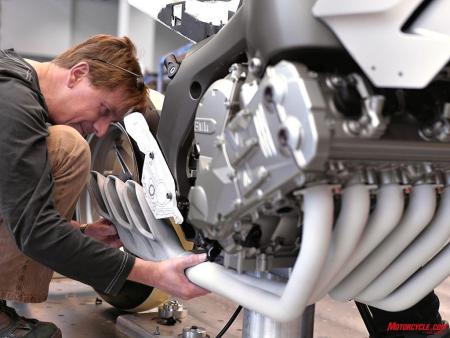
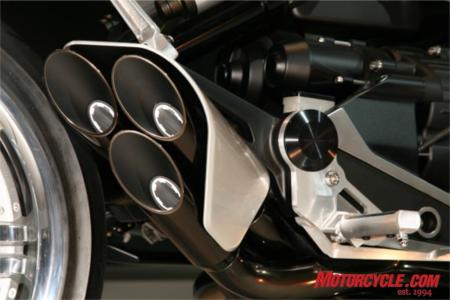
Exhaust routing on both bikes is highly stylized, with the BMW showcasing a six-into-two-into six system, each side featuring a trio of rectangular exhaust outlets. The Honda’s upswept GP-esque exhaust system appears to be a six-into-six format. It would be challenging for either system to meet EPA regulations, but some under-engine canisters might allow the basic designs to carry into production.

Visually the two bikes are keenly different from one another. The BMW is futuristic and stealthy in appearance; a motorcycle Hollywood would use in an upcoming sci-fi flick. Its “split face” design echoes a David Robb-penned theme seen in other BMWs, with the nose blending into the sidepods and carbon-fiber fuel tank.

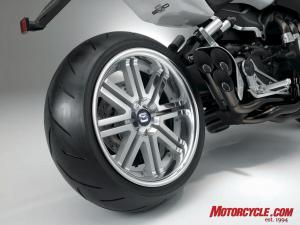
The Honda portends the brute force of a refined muscle car on two wheels, assisted by its fattish 220mm rear tire. Its handlebars are positioned higher than the BMW’s. Of note are the peg feelers on the EVO6, perhaps a sign that it might see a production line.

"The completion of this model run doesn't herald an end to this fabulous motorcycle,” Honda Motorcycle Division Vice President, Ray Blank, once said about the Rune: “Nor to Honda's determined pursuit of bringing concepts to production reality."

Of motorcycles currently in production, the Star/Yamaha VMax would be the closest match to this conceptual pair, boasting high-end features and a monstrous engine like these prototypes. However, the VMax’s near-$20K price has hurt its sales, a situation that might give pause to BMW and Honda.

Resting on a 66.9-inch wheelbase, the VMax scales in at 684 lbs full of fluids and boasts nearly 200 hp. The K1600GT already weighs just 703 lbs wet, so the Concept 6 could easily match the Max. But for the EVO6, that giant Gold Wing engine will ensure an optimistic mass of just below 800 lbs.

So, which would be a more desirable streetfighter grande? We’re not sure, but we’re betting BMW’s Concept 6 will be the first one you’ll see at a dealership.

As we noted in our K1600 Unveiled article, “BMW would be foolish not to amortize the cost of developing that powerplant by including it in another platform, and we’re reasonably sure BMW understands that, too.”

Read More ...


Source : http://www.motorcycle.com

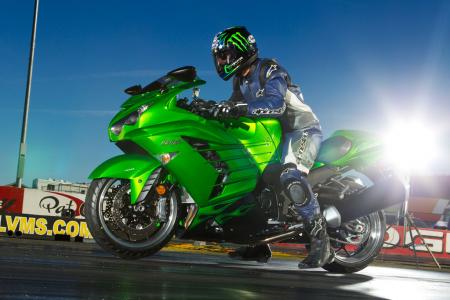
2012 Kawasaki ZX-14R Review

It’s neither easy nor politically correct to build the most powerful streetbike ever offered to the public for mass consumption, but that’s what Kawasaki has done with the incredibly potent new ZX-14R.
The ZX-14 has been a major player in the hyperbike wars since its introduction in 2006, becoming the only machine that could hold a candle to Suzuki’s mega-powerful (nearly 160 hp) Hayabusa that was introduced back in 1999. The ZX-14 cranked out a remarkable 171 hp on the dyno and must’ve worried Suzuki’s marketing department and engineering team, as they released a more powerful Hayabusa in 2008 with a bigger engine that produced around 165 horses.
Kawasaki surprised us with a revised ZX-14 in 2008, just two years since its debut, to meet the revitalized Suzuki challenger. While the Kawi remained the smoother and more accommodating choice, emissions regulations took a chunk out of the ZX’s top-end performance. Running excessively rich to preserve its catalyzers, the ZX spat out 10 peak horses less than the original.

his obviously didn’t sit well with Kawasaki, so they’ve now responded with the ZX-14R for 2012. Note the addition of the R to its name. Kawi’s engineers made a host of upgrades to the ZX’s powerplant, most notably by adding 4mm to the engine’s stroke that ups displacement from 1352cc to 1441cc. This 6.5% size increase plus hot-rodding tricks like hand-finished intake ports, more radical camshaft specs, a compression ratio increase and tapered exhaust headers has resulted in what Kawasaki claims is the most powerful mass-produced motorcycle engine in the world.
Read More ...


Source : http://www.motorcycle.com

Saturday, July 2, 2011

Chevrolet launches the upgraded 2012 Corvette

Chevrolet is about to make some improvement in the performance capabilities of the Corvette. The improvement is expected to be brought about by introducing a series of enhancements for the 2012 model year car. The enhancements have been decided upon with the objective to offer an on track performance and on road comfort, the quality of both of which would be better than the prevalent. The improvements on the performance are subtle and they concern the Z06 and ZR1 models. The rest of the lineup of Corvette also gets to receive upgrade in interior and equipment department though those are modest at best.
Among the features that are new to the 2012 MY Corvette include optional Michelin Pilot Sport Cup Zero Pressure tires. The tires would be available for the Z06 and the ZR1 versions that have a max power rating of 505 and 638 HP respectively. These competition based tires have increased cornering and handling capacity in the warm and dry conditions. These in combination with the Performance Traction Management technology or PTM are expected to offer a 8 percent gain in maximum lateral acceleration for the car, which is more than 1.1 g. Then there is a corresponding enhancement in braking performance as well with considerably shorter braking distances achieved.
The new Michelins finds its inclusion in the optional Z07 performance package for the Corvette Z06 and a new PDE performance package on the ZR1. The tires actually feature brand new wheels that flaunt the aluminum Cup-style. The wheels have either a satin black or machined finishes. The weight by which the wheels have gone lighter is about 5 pounds or 2.2 kgs though the strength has gone up in that it is now stronger than even a 20 spoke wheel.
There is yet another upgrade – the racing style spoiler that is part of both the Z07 and PDE packages. The Z06 will also get the Magnetic Selective Ride Control suspension technology and Brembo carbon ceramic brakes as part of the Z07 package. The optional extras that are further added make the inclusion of carbon fiber hood on the Z06 models and taller gearing for the ZR1 in 5th and 6th gear for an improvement of 2 mpg in the high way fuel economy rating.

As far as the inside of the car is concerned, all Corvette models of 2012 version will get new seat and steering wheel designs. Chevrolet describes the seats to have features like large bolsters and optional microfiber suede inserts. The bolsters contribute to the improvement in the lateral support. In addition to this, all models further receives contrasting color stitching that come in colors red, blue and yellow and padded center console and armrests.
Equipment levels of the car include the incorporation of a new Bose Audio System that has 9 speakers, 2 more than what was present in the 2011 version. The audio system is better tuned to the cabin’s acoustics. The 2LT trim level is said to be featuring new Technology Package that includes navigation, head up display, Bose premium audio system. In addition to all these, Bluetooth wireless phone connectivity and USB port will also be available in the coupe. After the long wait, the customers can finally make an option of choosing the braking caliper getting painted in red, yellow, silver or gray colors.
Production of the Corvette version 2012 begins in the month of July 2011.
Read More ...


Source : http://www.speedlux.com

Twitter Delicious Facebook Digg Stumbleupon Favorites More

 
Design by Free WordPress Themes | Bloggerized by Lasantha - Premium Blogger Themes | Walgreens Printable Coupons