Showing posts with label BMW MC. Show all posts

Wednesday, December 28, 2011

Six-Cylinder Streetfighter Shootout of the Future: Honda EVO6 vs BMW Concept 6

There are currently two motorcycles that have six-cylinder engines, and both of them power big and bulky touring machines: the BMW K1600 and Honda Gold Wing.

Both engines are large-displacement, high-torque powerplants that create sweet-sounding exhaust music, and we’ve wondered what other uses could be made from these unique engines.

We’re not the only ones, as designers from Honda and BMW have both shown concept motorcycles built around these motors, making us wonder if we might one day see a version of either enter production.

Honda was first to the game when it unveiled the EVO6 at the 2007 Tokyo Motor Show. A “Pride Fighter,” according to Honda, it was a bold concept streetfighter based around the company’s flat-Six engine from the Gold Wing.
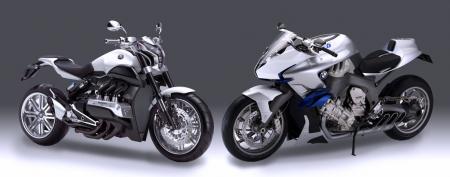
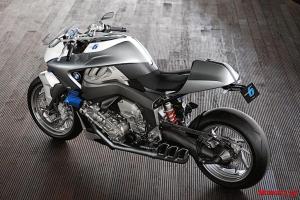
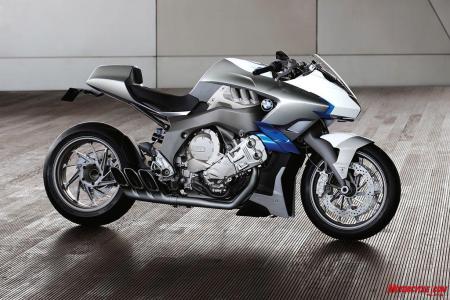
Two years later, at the EICMA show in Italy, BMW teased visitors with the Concept 6 streetfighter model based on a previously unseen inline six-cylinder engine that later debuted in the K1600 GT and GTL.

This year’s launch of BMW’s K1600 series strengthens the possibility of a production version of the Concept 6 becoming reality in the not-too-distant future. The EICMA show might’ve been BMW’s way of doing market research on the Concept 6’s viability.
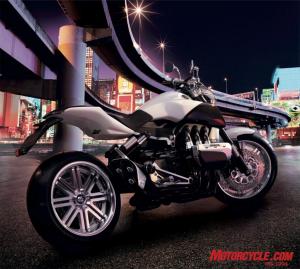
With four years having passed since a public appearance of Honda’s EVO6, the promise of that model coming to fruition dims, but like the limited-production, high-concept 2005 Rune that utilized the Gold Wing mill, we could be pleasantly surprised. It could be that Honda is just sitting on its hands waiting for the global economy to recover.
With neither bike a sure thing, we decided — in the spirit of a good, old, black and white Godzilla movie — to create some science fiction of our own; to pit one concept model against another by extrapolating information from the current models they’re derived from and combining that knowledge with the limited facts presented by the respective manufacturer.
The introduction of the BMW K1600 series sheds light on what the Concept 6 is capable of achieving. In its current touring guise the inline six-cylinder engine produces a claimed 160 hp and 129 ft-lb of torque. It’s likely a streetfighter like the 6 would be given performance tuning to bump up peak output somewhere near 180 hp at the crankshaft.
The larger displacement GL engine (1832cc vs 1649cc) cranks out a relatively paltry 118 hp but a more respectable 125 ft-lb of torque. The extinct Rune used hotter cams and 12-hole injectors to achieve a slight power upgrade, but we’d hope there’s more oomph than that lurking inside. In terms of sheer horsepower numbers, the Beemer will have a clear advantage.
The Rune, carrying about 840 lbs, could cover a standing-start quarter-mile in 12.5 seconds. In contrast, the lighter and more powerful BMW GTL can perform the same feat in the low 11-second range.
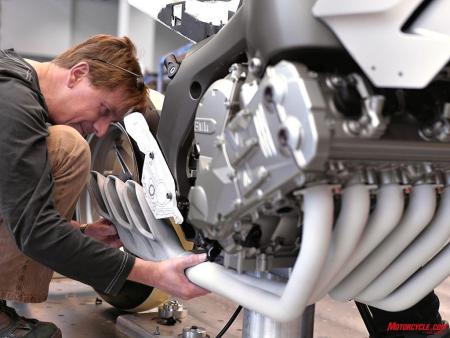
Obviously Honda must contend with this performance imbalance for its EVO6 to compete with BMW’s Concept 6. Perhaps underneath the EVO’s stylized cylinder-head covers is a new DOHC valvetrain and four-valve cylinders, which would go a long way in bringing more horses to Honda’s trough. The addition of gasoline-direct-injection technology would allow a bump in compression from its current 9.8:1 ratio to a figure commensurate with BMW’s 12.2:1.

According to Honda’s press material, the EVO6 is to utilize an automatic transmission, with two automatic shifting modes in addition to a bar-mounted toggle for operating the six-speed gearbox manually. With the introduction last year of the dual-clutch transmission in the VFR1200F, we’ll assume that technology would make it to this concept, and, likely, to the next Gold Wing.
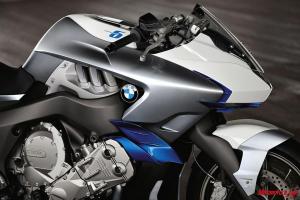
BMW makes no claims to advancing transmission technology. In fact, the Concept 6 closely resembles the company’s own K1300R, making it even more feasible that we’ll see this bike in dealerships as a pseudo replacement to the 1300R that isn’t imported to America. The K1300 platform will provide a base from which to construct the Concept 6 streetfighter, although a completely new frame will be necessary to hold its wider engine.

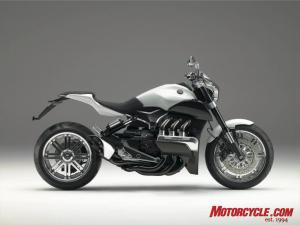
Besides the engine, the EVO6 shares little to nothing with other Honda models. The aluminum twin-spar frame on the Gold Wing is replaced by one with an aluminum backbone that uses the large engine as a stressed member. The EVO’s rear suspension is via twin dampers with remote reservoirs that appear to be sprung by air, leaving open the possibility of remote suspension adjustment (the current Gold Wing has an onboard air compressor for preload adjustment).

Up front the Honda wears a standard inverted fork, while the Concept 6 utilizes BMW’s Duolever front suspension technology borrowed from the K series. In the rear each bike sports a shaft final drive and a single-sided swingarm, just like their corporate brothers.

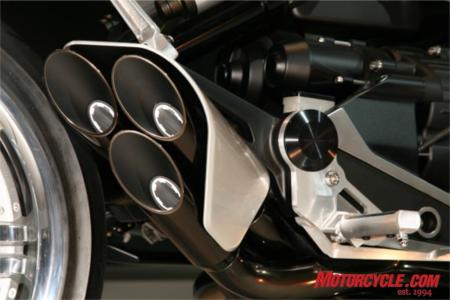
Exhaust routing on both bikes is highly stylized, with the BMW showcasing a six-into-two-into six system, each side featuring a trio of rectangular exhaust outlets. The Honda’s upswept GP-esque exhaust system appears to be a six-into-six format. It would be challenging for either system to meet EPA regulations, but some under-engine canisters might allow the basic designs to carry into production.

Visually the two bikes are keenly different from one another. The BMW is futuristic and stealthy in appearance; a motorcycle Hollywood would use in an upcoming sci-fi flick. Its “split face” design echoes a David Robb-penned theme seen in other BMWs, with the nose blending into the sidepods and carbon-fiber fuel tank.

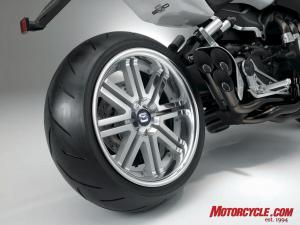
The Honda portends the brute force of a refined muscle car on two wheels, assisted by its fattish 220mm rear tire. Its handlebars are positioned higher than the BMW’s. Of note are the peg feelers on the EVO6, perhaps a sign that it might see a production line.
"The completion of this model run doesn't herald an end to this fabulous motorcycle,” Honda Motorcycle Division Vice President, Ray Blank, once said about the Rune: “Nor to Honda's determined pursuit of bringing concepts to production reality."

Of motorcycles currently in production, the Star/Yamaha VMax would be the closest match to this conceptual pair, boasting high-end features and a monstrous engine like these prototypes. However, the VMax’s near-$20K price has hurt its sales, a situation that might give pause to BMW and Honda.
Resting on a 66.9-inch wheelbase, the VMax scales in at 684 lbs full of fluids and boasts nearly 200 hp. The K1600GT already weighs just 703 lbs wet, so the Concept 6 could easily match the Max. But for the EVO6, that giant Gold Wing engine will ensure an optimistic mass of just below 800 lbs.

So, which would be a more desirable streetfighter grande? We’re not sure, but we’re betting BMW’s Concept 6 will be the first one you’ll see at a dealership.

As we noted in our K1600 Unveiled article, “BMW would be foolish not to amortize the cost of developing that powerplant by including it in another platform, and we’re reasonably sure BMW understands that, too.”
Read More ...


Source : http://www.motorcycle.com

Friday, May 27, 2011

2011 BMW S1000RR Street Comparison

It’s hard to imagine, but up until a couple years ago the words BMW and Superbike were about as relevant as Ferrari and station wagon… oh, how the times have changed. Today, the German brand has established itself as an omnipresent force with its 2011 BMW S1000RR. This technological masterpiece, with its surprising MSRP of $16,630 as tested here, features optional Dynamic Traction Control, Race ABS, Gear Shift Assist and Motorsports colorway.

Throw a leg over it and the BMW S1000RR cockpit feels remarkably similar to the Kawasaki and Suzuki. The 32-inch seat height is identical to the ZX and it offers adequate levels of sportbike comfort. However, it is not quite as luxurious as the GSX-R1000 seat. Reach to the controls and the handlebars are placed a bit low, equating to a more track-oriented feel than the Japanese bikes, yet it is still reasonable for the street. Likewise the foot controls place the rider in a more track-oriented attitude, which isn’t quite as comfortable either. Unfortunately, the position of the foot controls is fixed like the Honda and Ducati. The windshield is on the small side too, which works for riders of average height, but we wish it was a little taller. The rearview mirrors offer a clear view of everyone that you just smoked off the line too.

Considering its horizontal Inline-Four layout, this Beemer is a narrow motorcycle – maybe not quite as slim as the Honda but definitely close. With a full 4.5-gallon fuel load the S1000RR weighs in at 459 pounds, one pound less than the Suzuki but still 20 pounds heavier than the class-leading Kawasaki. Yet somehow BMW engineers managed to hide the weight well because you’ll be hard pressed to feel the difference when riding.
“It’s funny because the BMW feels a lot like the Japanese bikes,” reflects Gauger. “It’s pretty obvious what they were going after and I like what they’ve done. For me the ergonomics are comfortable, though they are a hair more aggressive than the Japanese bikes.”

In the Instrumentation/Electronics scoring category the BMW was rated highly— second to only the Kawasaki. The mixed analog/digital display is easy-to-use and read but the real bonus is its user-adjustable engine management system highlighted by an engine power/throttle mode selection with settings for Rain, Sport, Race and Slick (as in slick tires for the track). The system is a blend of the adjustable power mode set-ups employed in the Kawasaki and Suzuki with the addition of throttle sensitivity settings like the Yamaha. For street riding most of us preferred the ‘Sport’ setting as it made the throttle less-sensitive (like the Yamaha R1’s ‘B’ mode), which made the bike easier to control.

The optional $1480 Dynamic Traction Control and Race ABS adds functionality to the power mode selection with traction/wheelie control and ABS. The traction control performs better than the standard equipment found on the Ducati; however, it is a bit more restrictive-feeling than the set-up employed by the Kawasaki. Furthermore the wheelie control element does not feel refined, which can actually make the bike more difficult to control in an experienced rider’s hands so we left it turned off. No sense in dumbing down those 183 ponies because we love what that brings to the table.

“The BMW’s electronics package is hard to beat,” explains Steeves. “I love the adjustable power modes and even the TC works great too, but the wheelie control has got to go. It’s just way too jerky. You’ll start doing a wheelie and everything feels good than in an instant the front wheel slams back to the ground. Then a second later when the engine gets on the pipe again it wheelies again just to slam down. It’s so bad that I had to turn the TC off.”

Without a doubt the highlight of the BMW is its phenomenal engine. While it doesn’t have the bottom-end power of the Suzuki, or the mid-range of the Honda, bury the tach needle above 10,000 rpm mark and the BMW engine pumps out authentic World Superbike-grade levels of power – some 20-30 horsepower more than the competition! At 13,100 rpm the BMW cranks out 183.37 horsepower giving it title as most powerful bike in this test. It also churns out the most torque amongst the four-cylinders with 78.79 lb-ft @ 10,800 rpm. To our surprise, observed fuel mileage was the second-best too at 35.3 mpg, which also netted the second-farthest range of 158.8 miles between fuel stops. High horsepower and great fuel economy: Need we say more?

In spite of its mid-pack bottom-end and mid-range power, on paper the BMW shot from zero to 60 mph in just 2.70 seconds – 0.19 seconds faster than the runner-up GSX-R1000. In the quarter mile the German bike was the only one to break into the nines with a seriously fast time of 9.93 seconds. It also had the highest trap speed of 149.8 mph, 4.3 mph faster than the Kawasaki ZX-10R.

One of the features that helped it achieve such a blistering fast time was its Gear Shift Assist option (quick-shifter), which allows the rider to up-shift through the six-speed gearbox without letting off the throttle. Shorter final drive gearing of 17/44 didn’t hurt things, and its cable-actuated slipper-clutch has terrific feel as well as action during launch and, of course, on corner-entry, though it requires a little more lever pull.

The engine’s overall character also impressed us. In the sound test the S1000RR registered 82 dB at idle and 100 dB at 7000 rpm, identical to the Honda. Once the engine spins upwards of 10-grand, it emits a high-rpm shriek unlike anything else on the road. It feels like you’re at the controls of a two-wheeled Formula-1 race car. The sound of the S1000RR howling at high rpm has to be experienced to be believed. And it does all of this with very little engine vibration. 


BMW shocked the sportbike world with its S1000RR. See how it performed in this year’s shootout in the 2011 BMW S1000RR Street Comparison Video.
It’s hard to imagine, but up until a couple years ago the words BMW and Superbike were about as relevant as Ferrari and station wagon… oh, how the times have changed. Today, the German brand has established itself as an omnipresent force with its 2011 BMW S1000RR. This technological masterpiece, with its surprising MSRP of $16,630 as tested here, features optional Dynamic Traction Control, Race ABS, Gear Shift Assist and Motorsports colorway.

Throw a leg over it and the BMW S1000RR cockpit feels remarkably similar to the Kawasaki and Suzuki. The 32-inch seat height is identical to the ZX and it offers adequate levels of sportbike comfort. However, it is not quite as luxurious as the GSX-R1000 seat. Reach to the controls and the handlebars are placed a bit low, equating to a more track-oriented feel than the Japanese bikes, yet it is still reasonable for the street. Likewise the foot controls place the rider in a more track-oriented attitude, which isn’t quite as comfortable either. Unfortunately, the position of the foot controls is fixed like the Honda and Ducati. The windshield is on the small side too, which works for riders of average height, but we wish it was a little taller. The rearview mirrors offer a clear view of everyone that you just smoked off the line too.

Considering its horizontal Inline-Four layout, this Beemer is a narrow motorcycle – maybe not quite as slim as the Honda but definitely close. With a full 4.5-gallon fuel load the S1000RR weighs in at 459 pounds, one pound less than the Suzuki but still 20 pounds heavier than the class-leading Kawasaki. Yet somehow BMW engineers managed to hide the weight well because you’ll be hard pressed to feel the difference when riding.
(Above) Although it isn’t the lightest bike out there you’d be hard pressed to tell as the BMW S1000RR is very maneuverable bike. (Below) The BMW’s multi-mode engine power map and traction control system performs well and is easy-to-use.
“It’s funny because the BMW feels a lot like the Japanese bikes,” reflects Gauger. “It’s pretty obvious what they were going after and I like what they’ve done. For me the ergonomics are comfortable, though they are a hair more aggressive than the Japanese bikes.”

In the Instrumentation/Electronics scoring category the BMW was rated highly— second to only the Kawasaki. The mixed analog/digital display is easy-to-use and read but the real bonus is its user-adjustable engine management system highlighted by an engine power/throttle mode selection with settings for Rain, Sport, Race and Slick (as in slick tires for the track). The system is a blend of the adjustable power mode set-ups employed in the Kawasaki and Suzuki with the addition of throttle sensitivity settings like the Yamaha. For street riding most of us preferred the ‘Sport’ setting as it made the throttle less-sensitive (like the Yamaha R1’s ‘B’ mode), which made the bike easier to control.

The optional $1480 Dynamic Traction Control and Race ABS adds functionality to the power mode selection with traction/wheelie control and ABS. The traction control performs better than the standard equipment found on the Ducati; however, it is a bit more restrictive-feeling than the set-up employed by the Kawasaki. Furthermore the wheelie control element does not feel refined, which can actually make the bike more difficult to control in an experienced rider’s hands so we left it turned off. No sense in dumbing down those 183 ponies because we love what that brings to the table.

“The BMW’s electronics package is hard to beat,” explains Steeves. “I love the adjustable power modes and even the TC works great too, but the wheelie control has got to go. It’s just way too jerky. You’ll start doing a wheelie and everything feels good than in an instant the front wheel slams back to the ground. Then a second later when the engine gets on the pipe again it wheelies again just to slam down. It’s so bad that I had to turn the TC off.”

Without a doubt the highlight of the BMW is its phenomenal engine. While it doesn’t have the bottom-end power of the Suzuki, or the mid-range of the Honda, bury the tach needle above 10,000 rpm mark and the BMW engine pumps out authentic World Superbike-grade levels of power – some 20-30 horsepower more than the competition! At 13,100 rpm the BMW cranks out 183.37 horsepower giving it title as most powerful bike in this test. It also churns out the most torque amongst the four-cylinders with 78.79 lb-ft @ 10,800 rpm. To our surprise, observed fuel mileage was the second-best too at 35.3 mpg, which also netted the second-farthest range of 158.8 miles between fuel stops. High horsepower and great fuel economy: Need we say more?

In spite of its mid-pack bottom-end and mid-range power, on paper the BMW shot from zero to 60 mph in just 2.70 seconds – 0.19 seconds faster than the runner-up GSX-R1000. In the quarter mile the German bike was the only one to break into the nines with a seriously fast time of 9.93 seconds. It also had the highest trap speed of 149.8 mph, 4.3 mph faster than the Kawasaki ZX-10R.

One of the features that helped it achieve such a blistering fast time was its Gear Shift Assist option (quick-shifter), which allows the rider to up-shift through the six-speed gearbox without letting off the throttle. Shorter final drive gearing of 17/44 didn’t hurt things, and its cable-actuated slipper-clutch has terrific feel as well as action during launch and, of course, on corner-entry, though it requires a little more lever pull.

The engine’s overall character also impressed us. In the sound test the S1000RR registered 82 dB at idle and 100 dB at 7000 rpm, identical to the Honda. Once the engine spins upwards of 10-grand, it emits a high-rpm shriek unlike anything else on the road. It feels like you’re at the controls of a two-wheeled Formula-1 race car. The sound of the S1000RR howling at high rpm has to be experienced to be believed. And it does all of this with very little engine vibration.

“I love the BMW’s motor,” notes Dawes. “If you’re looking for the fastest superbike on the road then you need this bike. I can’t believe that you can even by something this fast—it’s incredible. I also like that the engine’s got some character. When you get the revs up it makes all the right noises which makes it more fun to ride than some of the others.”

In terms of handling, the BMW feels quite similar to the Honda and Kawasaki. It doesn’t steer with as much agility as those bikes, but it is close. In fact, it feels eerily similar to the GSX-R1000 and that is a good thing for street riders. The suspension does a good job of soaking up bumps on the tore up Southern California highways, yet still delivers a sporty ride in the canyons. It’s also a very stable bike, resisting the urge to
headshake or get out of control, which is a feat in itself considering how much power it puts to the back tire.

With all that power and velocity at your disposal, it’s nice to know that S1000RR front brakes are superior to the competition as well. We find that strange considering they are the lesser-grade two-piece cast 4-piston calipers as opposed to the more expensive monoblocs on the other Euro machines. In our braking performance test, the BMW tied the Kawasaki for first-place with a stopping distance of 129 feet from 60 mph performed in ‘Sport’ mode, which enables both front and rear ABS. This proves the effectiveness of its ABS, despite carrying 20 pounds more weight than the ZX-10R.

When the dust settled and the pink-slips tallied there was no denying the outcome of this test. For the second year in a row the BMW S1000RR proves that it offers motorcyclists the finest road-going Superbike. It continues to wow us with the extreme performance combination of its wicked-fast engine, more than capable chassis and awesome brakes. Furthermore, its sophisticated electronics package makes that performance more accessible to a wider range of riders. Say hello to the 2011 Superbike Smackdown VIII Street champion, the 2011 BMW S1000RR. 

Article Source: http://www.motorcycle-usa.com

Twitter Delicious Facebook Digg Stumbleupon Favorites More

 
Design by Free WordPress Themes | Bloggerized by Lasantha - Premium Blogger Themes | Walgreens Printable Coupons