If you don’t know what a ‘twitcher’ is then this list is probably not for you – then again, perhaps you don’t even know you’re
a twitcher yet. (Twitcher is just another name for birdwatcher.)
With over 10,000 species of birds in the world, twitchers travel far and wide to get a glimpse or catch the call of their favourite feathered friends. Modern-day shooting parties armed with cameras and binoculars flock to these 10 birdwatching hot spots.
 Image by tarotastic
This largely untouched and isolated archipelago has much wonderful natural habitat intact. The stars of the show are the fantastical birds of paradise, of which there are more than 40 species, all individually bizarre. With brilliant colours and showy, sweeping plumes, they engage in dazzling courtship displays, jumping, carolling and opening their feathers like Chinese fans. Another well-known character is the cassowary, a large flightless bird with a horny casque on its head to help it crash through the thick rainforest, and a fiercely sharp middle toe giving it a (probably exaggerated) reputation as the world’s most dangerous bird. Varirata National Parkis one of the top birdwatching sites.
 Image by babasteve
Better known for the Big Five of wild animals, Kruger is also the place to spot South Africa’s ‘big six’ birds – an irresistible challenge for birdwatchers determined to collect the set. They are the southern ground hornbill, Pel’s fishing-owl, lappetfaced vulture, saddle-billed stork, martial eagle and the kori bustard. All large and impressive, though not the most beautiful of creatures (particularly the vulture), they are mostly easy to spot. With much less kudos but just as thrilling for the traveller are the ostriches, often seen streaking across the savannah, and the common-as muck but oh-so-beautiful glossy starling, a shimmering jewel-like iridescent blue. There are safaris and accommodation options for all budgets at Kruger National Park; the northern section, particularly around the Luvuvhu River, is the best area to spot the birds.
 Image by eggshapedkath
You’re sure to have seen this image before – it’s part of the lovely flight scene from Out of Africa, for example – a flock of flamingos like a swirling drift of pink petals covering a lake. But seeing it in the flesh is one of those spine-tingling moments that stay with you forever. The noise is raucous. Up close, the elegant birds are almost comical, performing their elaborate, synchronised courtship dance. The lake in question isKenya’s Lake Nakuru, but sadly, for reasons that aren’t quite certain, the numbers of flamingos returning to the lake is dropping each year. It’s worth catching while you can. Lake Nakuru National Park is 2km south of the centre of Nakuru. There is a large public campsite just inside the main gate.
4. The Pantanal, Brazil
 Image by wildlifeshot
A major destination for birdwatching trips, the Pantanal is home to more bird species than all of North America. In this wetland region birds fly in flocks of thousands and six different species may nest on a single branch. The biggest Brazilian bird is also found here – the flightless rhea, which resembles a small ostrich. The smallest birds are the numerous hyperactive types of hummingbird. These beautiful little birds, with their dazzling iridescent colours, can be seen all over the country. They flit rapidly, almost insectlike, from one spot to the next, and can even fly backwards. The lyrical Brazilian name for them is beija-flor (flower-kisser). You can arrange guided tours (or head off on your own) from the gateway towns Cuiabá, Corumbá and Campo Grande. Reservations are needed for all accommodation in July.
 Image by Dunedin NZ
This wildlife region has become one of NZ’s hottest attractions, and its main drawcard is the birdlife. Taiaroa Head is the site of the world’s only mainland royal albatross breeding ground, where you can observe the incredible spectacle of soaring albatrosses, with up to 3m wingspans, coming in to land like a succession of 747s. Stewart Island is the best place to see the much-loved but very shy national icon, the kiwi, a flightless fluffy brown ball. The island is also home to one of the world’s rarest penguins, the endangered yellow-eyed penguin, named for their yellow feathered eye masks. The Royal Albatross Centre at Taiaroa Head is open daily and offers various tours as well as colony viewing. Bookings are essential.
6. Antarctica
Vast icy landscapes of haunting beauty are one drawcard for travellers; penguins, the symbol of Antarctica, are definitely another. With their comical waddle, social nature and will to live in the most inhospitable terrain on earth, penguins capture the imagination. Because of the scarcity of people, quiet observers may find themselves approached by curious birds. The four main species are the Adélie, chinstrap, gentoo and emperor, and they number literally in the millions. Emperor penguins are known for their valiant breeding cycle, marching miles from the ocean to their ancestral breeding grounds, where they endure bitter winters huddled together to incubate their eggs, before making the arduous journey back again to finally feed. Penguins will be a feature of all tours. The International Association of Antarctica Tour Operators website (www.iaato.org) provides lots of contact information.
7. Queensland, Australia
 Image by djpmapleferryman
As with its peculiar animals, Australia’s isolation has evolved some unusual birds. The laughing kookaburra really does sound like it’s laughing, while the spectacular tailed lyrebird sounds like any bird or other sound it chooses to mimic – in touristed areas it often sounds like a camera shutter. Then there are bowerbirds that compete for female attention by creating towering nests from pretty shiny things; the flightless emu – the world’s second largest bird after the ostrich; and a seemingly endless array of brilliantly coloured parrots. These birds can be mostly seen all over the country, but one place you’re sure to encounter them all is Currumbin Wildlife Sanctuary inQueensland, where flocks of friendly lorikeets are a hallmark attraction. Currumbin Wildlife Sanctuary is located in Currumbin on the Gold Coast.
8. Ecuador
 Image by ggallice
Like Brazil, Ecuador has a huge diversity of birdlife – over 1500 species. Among the best known and most colourful groups are toucans, which have huge rainbowcoloured beaks, sometimes as long as their bodies, enabling them to reach berries at the end of branches. Toucans live at forest treetop level and are often best seen from boats. Also at home in the rainforest canopy are macaws, particularly the blue and yellow variety. These large parrots’ clumsy antics and raucous music provide plenty of entertainment while exploring the jungle around the headwaters of the Amazon River. The riverside town of Tena is a natural jumping-off spot for rafting; many tour operators can be found on Avenida 15 de Noviembre.
9. Danube Delta, Romania
 Image by Alastair Rae
If you want to go birdwatching in Europe, word is that the Danube delta is the place to go. This network of channels, lagoons, reed islands, woods and pastures on the Black Sea coast, though sadly depleted by the activities of humans, remains a natural wonderland. Ornithological highlights include thousands of pelicans, herons, ibis, ducks, warblers and white-tailed eagles, but the real appeal of the region is the proximity you can get to them. Areas of the wetlands are only accessible by kayak or rowboat, from where you can watch the wildlife a mere arms-length away. The visitor permit required to enter the Danube Delta Biosphere Reserve can be purchased from travel agencies and hotels in the gateway town of Tulcea.
10. Alaska,USA
 Image by wsimmons
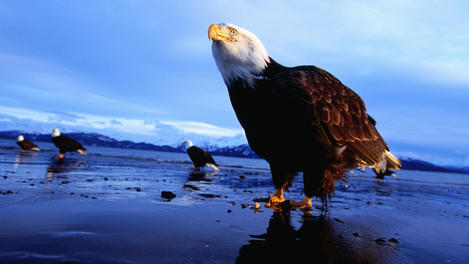
Much like great cats, birds of prey command respect and are always an object of fascination. One of the most sought after birds to sight is America’s emblematic bald eagle. Living atop lofty mountains and soaring to heights of 3,000m (10,000ft) they represent freedom, the nation’s most prized value. These magnificent raptors with their white heads and tails can be found in every state except Hawaii, but are most prevalent on the northwest coast. The best place to see them in large numbers is October to December on the Chilkat River in Alaska, where they gather for the annual salmon run. Chilkat Bald Eagle Preserve has excellent eagle-viewing areas about 30km from Haines along the Haines Highway.


 10:56 AM
 pocketstyle


 Posted in: