Saturday, June 11, 2011

Cheat Dota Allstars


Stuck on a single-player mission? These cheat codes can provide you with that 
"edge" you're looking for. To use a cheat code, press the ENTER key, 
type in the code, and press ENTER key again. The message "Cheat Code 
Enabled" should appear. Note that these codes only work in single-player missions and custom maps.  

Codes and effect:

TenthLevelTaurenChieftain
 - Plays a special song (WarCraft III: The Frozen Throne ONLY)
WarpTen - Speeds construction of buildings and units
IocainePowder - Fast Death/Decay
WhosYourDaddy - God mode
KeyserSoze [amount] - Gives you X Gold
LeafitToMe [amount] - Gives you X Lumber
GreedIsGood [amount] - Gives you X Gold and Lumber
PointBreak - Removes food limit
ThereIsNoSpoon - Unlimited Mana
TheDudeAbides - Fast spell cooldown
StrengthAndHonor - No defeat
ItVexesMe - No victory
Motherland [race] [level] - level jump
SomebodySetUpUsTheBomb - Instant defeat
AllYourBaseAreBelongToUs - Instant victory
WhoIsJohnGalt - Enable research
SharpAndShiny - Research upgrades
IseeDeadPeople - Remove fog of war
Synergy - Disable tech tree requirements
RiseAndShine - Set time of day to dawn
LightsOut - Set time of day to dusk
DayLightSavings [time] - If a time is specified, time of day is set to that, otherwise time of day is alternately halted/resumed


TenthLevelTaurenChieftain - Plays a special song(WarCraft III: The Frozen Throne ONLY)
WarpTen                   - Speeds construction of buildings and units
IocainePowder             - Fast Death/Decay
WhosYourDaddy             - God mode
KeyserSoze [amount]       - Gives you X Gold
LeafitToMe [amount]       - Gives you X Lumber
GreedIsGood [amount]      - Gives you X Gold and Lumber
PointBreak                - Removes food limit
ThereIsNoSpoon            - Unlimited Mana
TheDudeAbides             - Fast spell cooldown
StrengthAndHonor          - No defeat
ItVexesMe                 - No victory
Motherland [race] [level] - level jump
SomebodySetUpUsTheBomb    - Instant defeat
AllYourBaseAreBelongToUs  - Instant victory
WhoIsJohnGalt             - Enable research
SharpAndShiny             - Research upgrades
IseeDeadPeople            - Remove fog of war
Synergy                   - Disable tech tree requirements
RiseAndShine              - Set time of day to dawn
LightsOut                 - Set time of day to dusk
DayLightSavings [time]    - If a time is specified, time of day is
                            set to that, otherwise time of day is 
                            alternately halted/resumed

Hints for Kardel Sharpeye:
--------------------------
Kardel is one of the easiest heroes to control in the game.But you can
turn him into one of the strongest heroes you have ever seen. Kardel is
an AGI type hero so what he needs are agility items. He has low life so 
he is considered "soft" so you need to make him "harder".He is also ranged
and has a slow attacked speed so he needs items to increase attack speed 
and his over all speed.Here are the items that Kardel needs to improve 
himself:

1. Quarter staff-he really needs this thing!
2. Boots of Speed-he is so damn slow!
3. Boots of Travel-composed of Boots of speed-if you have enough money buy
   this thing so that he can teleport himself.
4. Helm of Dominator-comprised of Mask of Death and Helm of Iron will-this 
   will give him life steal and the ability to control creeps.
5. Butterfly-comprised of Eagle Horn,Quarter Staff(that's why you really 
   need it), and the Butterfly itself-if you want to,double this thing so 
   that you have a 60% chance of dodging attacks and it increases your hit
   points too. 
6. Power Treads-Keep clicking it to add up to your hit points or your life.
7. Bracer-composed of Gauntlets of Strength and circlet of nobilty-probably
   one of the most important stuff that you need on Kardel.This thing gives
   Kardel the toughness that he needs.

Tips for Jah'rakal:
-------------------
Level tips: Take only Jah'rakal's third and first skill when you're at the 
starting level of 1-5. Take the last skill when you reach level 6. DO NOT take
Jah'rakal's second skill unless you've already maxed-out your 1st, 3rd, last 
skill and your stats.

Note: Try "Harassment" meaning; simply killing/scaring or putting your enemy
Hero to near-death from the start and not letting him/her level up, this would 
guarantee you a sure win in your 1 on 1 Battle.

Item tips: At your starting level. Try get 3 "Wraith Bands", a "Boots of
Speed or Power Treads (Green= Agility)", a "Ring of Basilius (you may choose
Helm of the Dominator or Mask of Death if you're trying to save-up gold)", and a
"Teleportation Scroll (or 2 Healing Salves instead)". If you have achieved a
high level (level 6 or so). Try saving-up gold for the following items: "Sange and
Yasha", "Buriza do Kyanon", "Satanic", "The Butterfly",
a "Cranium Basher (you may replace this instead with the Black King Bar)", and
the "Eye of Skadi" (you may replace this with the Stygian Desolator or Lothar's
Edge).

A Lot of Gold:
--------------
Press the Space bar the type "-test" and after that type again "-Gold 999999999" 
Eigth 9s because it says on description it was only 4 but if you double it (8) 
That's how you get a lot of money!
Read More ...

Toyota Prius Plug-in Hybrid


technology

The Prius Plug-in is the most advanced member of the Prius Family yet. Combining an extended all-electric mode [1][2] with proven hybrid technology, it can get you up to 475 miles before your next fill-up, depending on driving conditions. [3] You also get the convenience of plug-in charging with rapid recharge times.

Learn more about the technologies below.

battery

  • Battery typeLithium-ion
  • Maximum EV cruising rangeApproximately 13 miles
  • Recharging time1.5 hours @ 240V AC or 3 hours at 120V AC
The idea of battery-powered cars is cool. But in reality, the weight, size, cost and durability of the large-capacity batteries required to fully power Electric Vehicles (EV) are critical issues that aren't fully solved. Our answer? Small lithium-ion battery packs that complement the proven Prius hybrid-electric power train.
The Prius Plug-in's lithium-ion battery is lightweight and compact, weighing a total of just 330 lb. So you get useful EV power and driving range without the costs of an electric-only EV battery, while maintaining plenty of cargo space and seating for five. Also, charge time from a standard 120V household outlet is only 3 hours.
Built to last for the life of the vehicle, our lithium-ion batteries have undergone more than three years of coordinated field testing in Japan, North America and Europe, in a wide variety of climatic environments and driving conditions.

engine

  • Displacement (cm3)1798
  • Max output [hp (kW)/rpm]98 (73)/5200
  • Max torque (Nm/rpm)142/4000
The Prius Plug-in's 4-cylinder engine is incredibly fuel-efficient. The first reason for this is its 1.8L displacement, which allows it to generate higher output and torque while operating at lower speeds. In addition to increased efficiency, you also get a much quieter ride.
Another factor is the elimination of the drive belt, along with an electric-driven water pump, which reduces supplemental engine load. This allows the engine to control the flow of coolant with increased precision based on vehicle conditions.
The engine also features a Cool-EGR system to lower recirculated exhaust temperatures, as well as a recirculation system that reuses heat to help the Prius Plug-in warm up even quicker.

motor

The electric motor in the Prius Plug-in is specially calibrated to give you greater fuel efficiency across a variety of driving conditions. And since it operates at an incredibly high rotational speed, it's able to generate more output in a smaller, lighter design—which also helps improve your overall fuel economy.

Source : http://www.toyota.com

Friday, June 10, 2011

Top 10 destinations for twitchers


If you don’t know what a ‘twitcher’ is then this list is probably not for you – then again, perhaps you don’t even know you’re 

a twitcher yet. (Twitcher is just another name for birdwatcher.)
With over 10,000 species of birds in the world, twitchers travel far and wide to get a glimpse or catch the call of their favourite feathered friends. Modern-day shooting parties armed with cameras and binoculars flock to these 10 birdwatching hot spots.

1. Papua New Guinea

Image by tarotastic
This largely untouched and isolated archipelago has much wonderful natural habitat intact. The stars of the show are the fantastical birds of paradise, of which there are more than 40 species, all individually bizarre. With brilliant colours and showy, sweeping plumes, they engage in dazzling courtship displays, jumping, carolling and opening their feathers like Chinese fans. Another well-known character is the cassowary, a large flightless bird with a horny casque on its head to help it crash through the thick rainforest, and a fiercely sharp middle toe giving it a (probably exaggerated) reputation as the world’s most dangerous bird. Varirata National Parkis one of the top birdwatching sites.

2. Kruger National Park, South Africa

Image by babasteve
Better known for the Big Five of wild animals, Kruger is also the place to spot South Africa’s ‘big six’ birds – an irresistible challenge for birdwatchers determined to collect the set. They are the southern ground hornbill, Pel’s fishing-owl, lappetfaced vulture, saddle-billed stork, martial eagle and the kori bustard. All large and impressive, though not the most beautiful of creatures (particularly the vulture), they are mostly easy to spot. With much less kudos but just as thrilling for the traveller are the ostriches, often seen streaking across the savannah, and the common-as muck but oh-so-beautiful glossy starling, a shimmering jewel-like iridescent blue. There are safaris and accommodation options for all budgets at Kruger National Park; the northern section, particularly around the Luvuvhu River, is the best area to spot the birds.

3. Rift Valley, Kenya

Image by eggshapedkath
You’re sure to have seen this image before – it’s part of the lovely flight scene from Out of Africa, for example – a flock of flamingos like a swirling drift of pink petals covering a lake. But seeing it in the flesh is one of those spine-tingling moments that stay with you forever. The noise is raucous. Up close, the elegant birds are almost comical, performing their elaborate, synchronised courtship dance. The lake in question isKenya’s Lake Nakuru, but sadly, for reasons that aren’t quite certain, the numbers of flamingos returning to the lake is dropping each year. It’s worth catching while you can. Lake Nakuru National Park is 2km south of the centre of Nakuru. There is a large public campsite just inside the main gate.

4. The Pantanal, Brazil

Image by wildlifeshot
A major destination for birdwatching trips, the Pantanal is home to more bird species than all of North America. In this wetland region birds fly in flocks of thousands and six different species may nest on a single branch. The biggest Brazilian bird is also found here – the flightless rhea, which resembles a small ostrich. The smallest birds are the numerous hyperactive types of hummingbird. These beautiful little birds, with their dazzling iridescent colours, can be seen all over the country. They flit rapidly, almost insectlike, from one spot to the next, and can even fly backwards. The lyrical Brazilian name for them is beija-flor (flower-kisser). You can arrange guided tours (or head off on your own) from the gateway towns Cuiabá, Corumbá and Campo Grande. Reservations are needed for all accommodation in July.

5. Otago Peninsula, New Zealand

Image by Dunedin NZ
This wildlife region has become one of NZ’s hottest attractions, and its main drawcard is the birdlife. Taiaroa Head is the site of the world’s only mainland royal albatross breeding ground, where you can observe the incredible spectacle of soaring albatrosses, with up to 3m wingspans, coming in to land like a succession of 747s. Stewart Island is the best place to see the much-loved but very shy national icon, the kiwi, a flightless fluffy brown ball. The island is also home to one of the world’s rarest penguins, the endangered yellow-eyed penguin, named for their yellow feathered eye masks. The Royal Albatross Centre at Taiaroa Head is open daily and offers various tours as well as colony viewing. Bookings are essential.

6. Antarctica

Image by Anne Froehlich
Vast icy landscapes of haunting beauty are one drawcard for travellers; penguins, the symbol of Antarctica, are definitely another. With their comical waddle, social nature and will to live in the most inhospitable terrain on earth, penguins capture the imagination. Because of the scarcity of people, quiet observers may find themselves approached by curious birds. The four main species are the Adélie, chinstrap, gentoo and emperor, and they number literally in the millions. Emperor penguins are known for their valiant breeding cycle, marching miles from the ocean to their ancestral breeding grounds, where they endure bitter winters huddled together to incubate their eggs, before making the arduous journey back again to finally feed. Penguins will be a feature of all tours. The International Association of Antarctica Tour Operators website (www.iaato.org) provides lots of contact information.

7. Queensland, Australia

Image by djpmapleferryman
As with its peculiar animals, Australia’s isolation has evolved some unusual birds. The laughing kookaburra really does sound like it’s laughing, while the spectacular tailed lyrebird sounds like any bird or other sound it chooses to mimic – in touristed areas it often sounds like a camera shutter. Then there are bowerbirds that compete for female attention by creating towering nests from pretty shiny things; the flightless emu – the world’s second largest bird after the ostrich; and a seemingly endless array of brilliantly coloured parrots. These birds can be mostly seen all over the country, but one place you’re sure to encounter them all is Currumbin Wildlife Sanctuary inQueensland, where flocks of friendly lorikeets are a hallmark attraction. Currumbin Wildlife Sanctuary is located in Currumbin on the Gold Coast.

8. Ecuador

Image by ggallice
Like Brazil, Ecuador has a huge diversity of birdlife – over 1500 species. Among the best known and most colourful groups are toucans, which have huge rainbowcoloured beaks, sometimes as long as their bodies, enabling them to reach berries at the end of branches. Toucans live at forest treetop level and are often best seen from boats. Also at home in the rainforest canopy are macaws, particularly the blue and yellow variety. These large parrots’ clumsy antics and raucous music provide plenty of entertainment while exploring the jungle around the headwaters of the Amazon River. The riverside town of Tena is a natural jumping-off spot for rafting; many tour operators can be found on Avenida 15 de Noviembre.

9. Danube Delta, Romania

Image by Alastair Rae
If you want to go birdwatching in Europe, word is that the Danube delta is the place to go. This network of channels, lagoons, reed islands, woods and pastures on the Black Sea coast, though sadly depleted by the activities of humans, remains a natural wonderland. Ornithological highlights include thousands of pelicans, herons, ibis, ducks, warblers and white-tailed eagles, but the real appeal of the region is the proximity you can get to them. Areas of the wetlands are only accessible by kayak or rowboat, from where you can watch the wildlife a mere arms-length away. The visitor permit required to enter the Danube Delta Biosphere Reserve can be purchased from travel agencies and hotels in the gateway town of Tulcea.

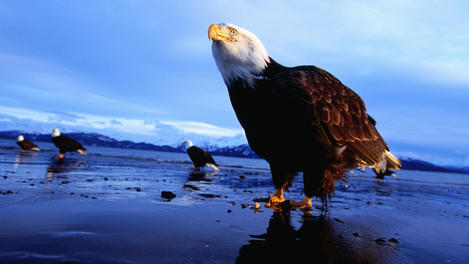
10. Alaska,USA

Image  by wsimmons
Much like great cats, birds of prey command respect and are always an object of fascination. One of the most sought after birds to sight is America’s emblematic bald eagle. Living atop lofty mountains and soaring to heights of 3,000m (10,000ft) they represent freedom, the nation’s most prized value. These magnificent raptors with their white heads and tails can be found in every state except Hawaii, but are most prevalent on the northwest coast. The best place to see them in large numbers is October to December on the Chilkat River in Alaska, where they gather for the annual salmon run. Chilkat Bald Eagle Preserve has excellent eagle-viewing areas about 30km from Haines along the Haines Highway.

Twitter Delicious Facebook Digg Stumbleupon Favorites More

 
Design by Free WordPress Themes | Bloggerized by Lasantha - Premium Blogger Themes | Walgreens Printable Coupons