9:09 AM
 www.pocketstyles.blogspot.com

There are currently two motorcycles that have six-cylinder engines, and both of them power big and bulky touring machines: the BMW K1600 and Honda Gold Wing.
Both engines are large-displacement, high-torque powerplants that create sweet-sounding exhaust music, and we’ve wondered what other uses could be made from these unique engines.
We’re not the only ones, as designers from Honda and BMW have both shown concept motorcycles built around these motors, making us wonder if we might one day see a version of either enter production.
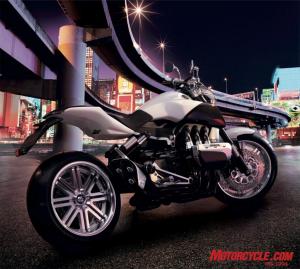
Honda was first to the game when it unveiled the EVO6 at the 2007 Tokyo Motor Show. A “Pride Fighter,” according to Honda, it was a bold concept streetfighter based around the company’s flat-Six engine from the Gold Wing.
Both engines are large-displacement, high-torque powerplants that create sweet-sounding exhaust music, and we’ve wondered what other uses could be made from these unique engines.
We’re not the only ones, as designers from Honda and BMW have both shown concept motorcycles built around these motors, making us wonder if we might one day see a version of either enter production.
Honda was first to the game when it unveiled the EVO6 at the 2007 Tokyo Motor Show. A “Pride Fighter,” according to Honda, it was a bold concept streetfighter based around the company’s flat-Six engine from the Gold Wing.
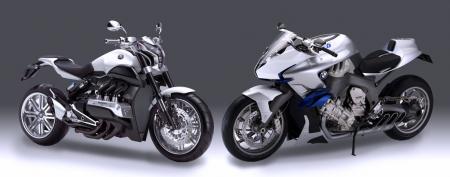
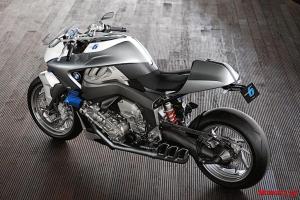
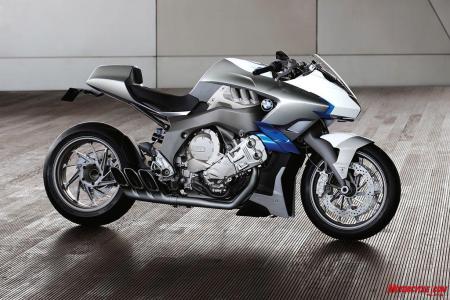
Two years later, at the EICMA show in Italy, BMW teased visitors with the Concept 6 streetfighter model based on a previously unseen inline six-cylinder engine that later debuted in the K1600 GT and GTL.
This year’s launch of BMW’s K1600 series strengthens the possibility of a production ver sion of the Concept 6 becoming reality in the not-too-distant future. The EICMA show might’ve been BMW’s way of doing market research on the Concept 6’s viability.
 sion of the Concept 6 becoming reality in the not-too-distant future. The EICMA show might’ve been BMW’s way of doing market research on the Concept 6’s viability.
With four years having passed since a public appearance of Honda’s EVO6, the promise of that model coming to fruition dims, but like the limited-production, high-concept 2005 Rune that utilized the Gold Wing mill, we could be pleasantly surprised. It could be that Honda is just sitting on its hands waiting for the global economy to recover.
With neither bike a sure thing, we decided — in the spirit of a good, old, black and white Godzilla movie — to create some science fiction of our own; to pit one concept model against another by extrapolating information from the current models they’re derived from and combining that knowledge with the limited facts presented by the respective manufacturer.
The introduction of the BMW K1600 series sheds light on what the Concept 6 is capable of achieving. In its current touring guise the inline six-cylinder engine produces a claim ed 160 hp and 129 ft-lb of torque. It’s likely a streetfighter like the 6 would be given performance tuning to bump up peak output somewhere near 180 hp at the crankshaft.
 ed 160 hp and 129 ft-lb of torque. It’s likely a streetfighter like the 6 would be given performance tuning to bump up peak output somewhere near 180 hp at the crankshaft.
The larger displacement GL engine (1832cc vs 1649cc) cranks out a relatively paltry 118 hp but a more respectable 125 ft-lb of torque. The extinct Rune used hotter cams and 12-hole injectors to achieve a slight power upgrade, but we’d hope there’s more oomph than that lurking inside. In terms of sheer horsepower numbers, the Beemer will have a clear advantage.
The Rune, carrying about 840 lbs, could cover a standing-start quarter-mile in 12.5 seconds. In contrast, the lighter and more powerful BMW GTL can perform the same feat in the low 11-second range.
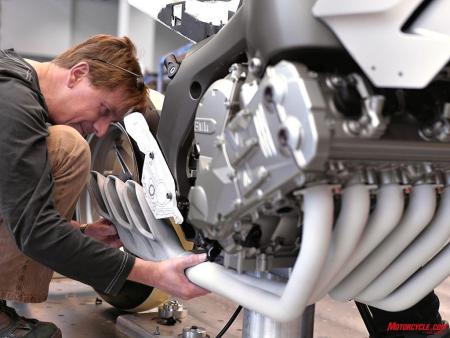 Obviously Honda must contend with this performance imbalance for its EVO6 to compete with BMW’s Concept 6. Perhaps underneath the EVO’s stylized cylinder-head covers is a new DOHC valvetrain and four-valve cylinders, which would go a long way in bringing more horses to Honda’s trough. The addition of gasoline-direct-injection technology would allow a bump in compression from its current 9.8:1 ratio to a figure commensurate with BMW’s 12.2:1.
According to Honda’s press material, the EVO6 is to utilize an automatic transmission, with
 two automatic shifting modes in addition to a bar-mounted toggle for operating the six-speed gearbox manually. With the introduction last year of the dual-clutch transmission in the VFR1200F, we’ll assume that technology would make it to this concept, and, likely, to the next Gold Wing.
BMW makes no claims to advancing transmission technology. In fact, the Concept 6 closely resembles the company’s own K1300R, making it even more feasible that we’ll see this bike in dealerships as a pseudo replacement to the 1300R that isn’t imported to America. The K1300 platform will provide a base from which to construct the Concept 6 streetfighter, although a completely new frame will be necessary to hold its wider engine.
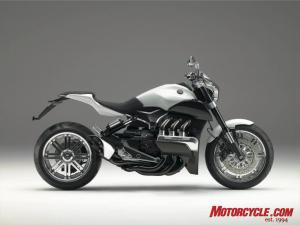
Besides the engine, the EVO6 shares little to nothing with other Honda models. The aluminum twin-spar frame on the Gold Wing is replaced by one with an aluminum backbone that uses the large engine as a stressed member. The EVO’s rear suspension is via twin dampers with remote reservoirs that appear to be sprung by air, leaving open the possibility of remote suspension adjustment (the current Gold Wing has an onboard air compressor for preload adjust
 ment).
Up front the Honda wears a standard inverted fork, while the Concept 6 utilizes BMW’s Duolever front suspension technology borrowed from the K series. In the rear each bike sports a shaft final drive and a single-sided swingarm, just like their corporate brothers.
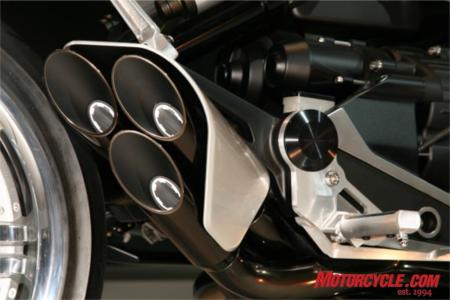
Exhaust routing on both bikes is highly stylized, with the BMW showcasing a six-into-two-into six system, each side featuring a trio of rectangular exhaust outlets. The Honda’s upswept GP-esque exhaust system appears to be a six-into-six format. It would be challenging for either system to meet EPA regulations, but some under-engine canisters might allow the basic designs to carry into production.
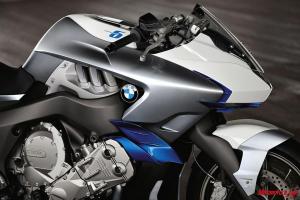
Visually the two bikes are keenly different from one another. The BMW is futuristic and stealthy in appearance; a motorcycle Hollywood would use in an upcoming sci-fi flick. Its “split face” design echoes a David Robb-penned theme seen in other BMWs, with the nose blending into the sidepods and carbon-fiber fuel tank.
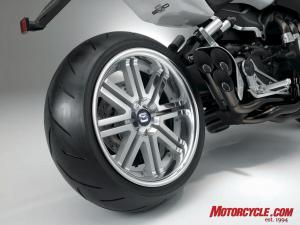
The Honda portends the brute force of a refined muscle car on two wheels, assisted by its fattish 220mm rear tire. Its handlebars are positioned higher than the BMW’s. Of note are the peg feelers on the EVO6, perhaps a sign that it might see a production line.
"The completion of this model run doesn't herald an end to this fabulous motorcycle,” Honda Motorcycle Division Vice President, Ray Blank, once said about the Rune: “Nor to Honda's determined pursuit of bringing concepts to production reality."
Of motorcycles currently in production, the Star/Yamaha VMax would be the closest match to this conceptual pair, boasting high-end features and a monstrous engine like these prototypes. However, the VMax’s near-$20K price has hurt its sales, a situation that might give pause to BMW and Honda.
 Resting on a 66.9-inch wheelbase, the VMax scales in at 684 lbs full of fluids and boasts nearly 200 hp. The K1600GT already weighs just 703 lbs wet, so the Concept 6 could easily match the Max. But for the EVO6, that giant Gold Wing engine will ensure an optimistic mass of just below 800 lbs.
So, which would be a more desirable streetfighter grande? We’re not sure, but we’re betting BMW’s Concept 6 will be the first one you’ll see at a dealership.
As we noted in our K1600 Unveiled article, “BMW would be foolish not to amortize the cost of developing that powerplant by including it in another platform, and we’re reasonably sure BMW understands that, too.”
Read More ...
Source : http://www.motorcycle.com
 Posted in: